The Field Service Operator's Guide to the Machine Economy
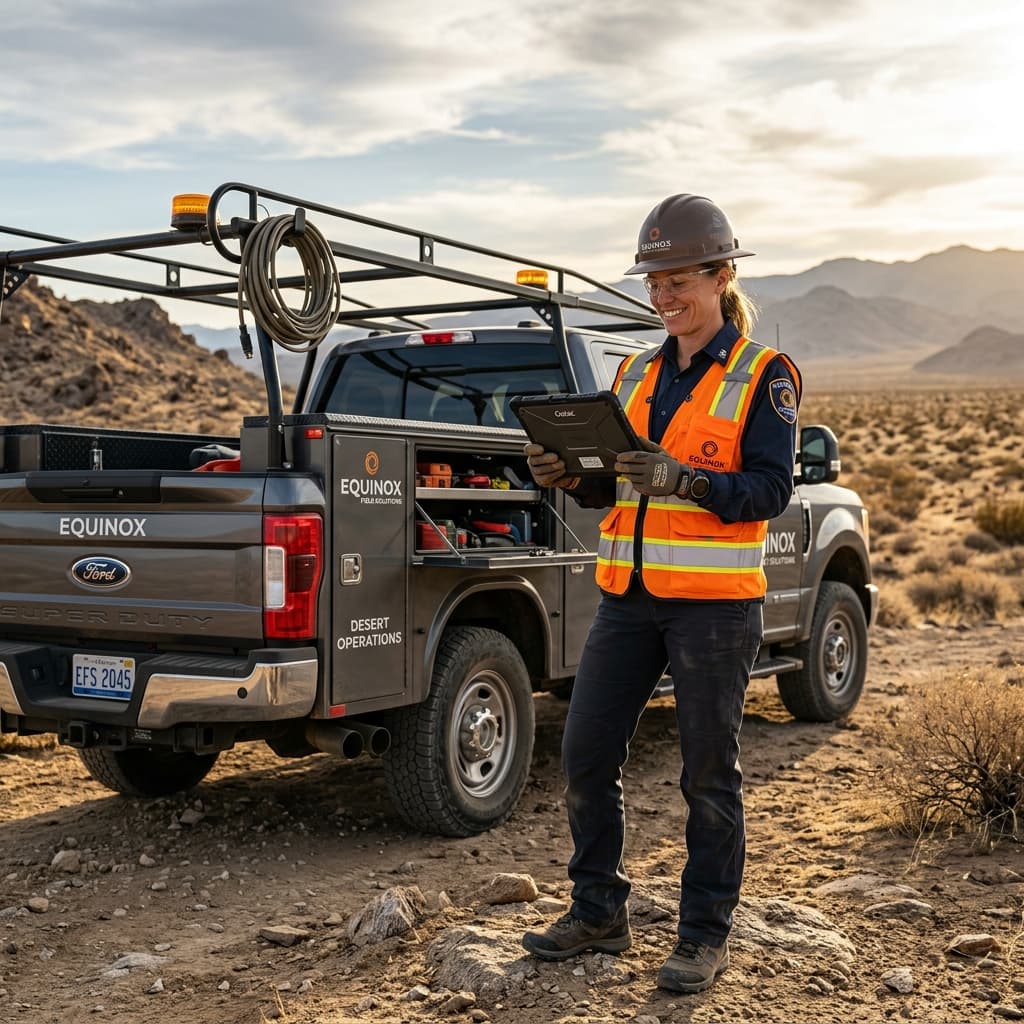
Who this is for: HVAC, plumbing, portable sanitation, pest control, landscaping, and equipment rental operators who run real trucks, real crews, and real schedules. If you have a dispatch board and a quoting system, this guide shows you how to make them work for AI agents, not just humans.
The Job You Are Losing Right Now
The field service industry is shifting rapidly; if your availability and pricing are not exposed via machine-readable API endpoints, you are actively losing jobs to competitors who operate headless architectures that AI assistants can instantly query and book.
A property manager in Phoenix tells their AI assistant: "I need 4 portable restrooms delivered to a job site on McDowell Road by Monday. Get me quotes from 3 companies."
The assistant queries every business in the area that has published machine-readable capabilities. It finds two companies with MCP endpoints that return real-time availability and pricing. It gets quotes from both in under 3 seconds.
Your company has a great website. Professional photos of your fleet. A phone number. A contact form.
The assistant skips you entirely. It cannot read your availability. It cannot pull a price. It does not know your service zone. You are invisible.
The first operator in your market to publish machine-readable dispatch, quoting, and scheduling capabilities will capture every AI-routed job. The rest will compete for whatever is left.
What "Machine-Readable" Means for Field Service
Machine-readable infrastructure means wrapping your existing CRM, like Jobber or ServiceTitan, in a Model Context Protocol (MCP) endpoint, enabling AI agents to programmatically verify schedule availability and execute bookings without human intervention.
You already have structured data. Your dispatch system knows which trucks are available. Your quoting tool calculates prices based on unit count, duration, and delivery distance. Your scheduling calendar shows open windows.
The problem is that all of this data is locked behind software that only your office staff can access. An AI agent cannot call your dispatcher. It cannot log into your CRM. It cannot use your website's contact form.
MCP gives AI agents a direct line to your operational systems. Think of it as adding a second front desk that never sleeps, never puts anyone on hold, and responds in milliseconds.
A2A (Agent-to-Agent protocol) makes you discoverable. It is the machine equivalent of being listed in the phone book. Without it, agents do not know you exist.
Human vs Machine Dispatch Architecture
Relying exclusively on human dispatchers creates a linear bottleneck in revenue velocity, whereas A2A dispatch enables concurrent, instantaneous job routing and zero-latency quotes for an unlimited volume of simultaneous inbound requests.
| Dispatch Dimension | Traditional Human Dispatch | A2A Machine Dispatch |
|---|---|---|
| Response Time | 5-30 minutes | Under 300 milliseconds |
| Concurrency Limit | 1 caller per dispatcher | Unlimited simultaneous requests |
| Quote Accuracy | Prone to manual entry errors | 100% mathematically precise |
| Availability Lookup | Manual calendar cross-referencing | Instant SQL/API constraint check |
| Operating Cost | $40k-$60k+ per seat annually | Near-zero marginal cost |
| Off-Hours Routing | Goes to voicemail | Fully operational 24/7 |
The 5 Tools Every Field Service Operator Needs
To capture AI-routed demand, a field service operator must deploy five specific MCP tools: check_availability, get_quote, schedule_delivery, get_compliance_docs, and get_job_status, ensuring all operational phases are programmatically accessible.
Tool 1: check_availability
What it does: Returns available units by type, date, and service zone. Why it matters: This is the first thing every agent checks. If you cannot answer "do you have 4 standard units available for June 2-20 in ZIP 85004?" in under a second, the agent moves to the next provider.
Tool 2: get_quote
What it does: Returns pricing based on unit count, duration, delivery distance, and any add-ons (hand wash stations, ADA units). Why it matters: Agents compare quotes from multiple providers. The operator who returns a structured, itemized quote wins.
Tool 3: schedule_delivery
What it does: Books a delivery with crew assignment, vehicle assignment, and confirmed delivery window. Why it matters: The transaction layer. You go from "lead" to "booked job" without a phone call.
Tool 4: get_compliance_docs
What it does: Returns required permits, safety documentation, or regulatory forms by jurisdiction. Why it matters: Construction sites have strict compliance requirements. Supplying documentation instantly saves the customer a follow-up call.
Tool 5: get_job_status
What it does: Returns real-time status on active deliveries, pickups, and service visits. Why it matters: Solves the "Where is my technician?" query programmatically via GPS tracking integrations.
Building an MCP Endpoint for Jobber
Converting a legacy field service CRM into a machine-readable node requires deploying a secure Next.js edge function that translates incoming AI requests into exact REST API payloads for your underlying dispatch system.
Here is a runnable Next.js API route demonstrating how to wrap a Jobber API webhook into an MCP-compliant check_availability endpoint:
import { NextResponse } from 'next/server';

// MCP-Compliant check_availability Endpoint
export async function POST(req: Request) {
  try {
    const body = await req.json();
    const { date, service_type, zip_code } = body;

    // Validate incoming parameters strictly
    if (!date || !service_type || !zip_code) {
      return NextResponse.json({
        error: "Missing required parameters: date, service_type, zip_code"
      }, { status: 400 });
    }

    // Call Jobber GraphQL or REST API
    const jobberResponse = await fetch('https://api.getjobber.com/api/graphql', {
      method: 'POST',
      headers: {
        'Authorization': `Bearer ${process.env.JOBBER_ACCESS_TOKEN}`,
        'Content-Type': 'application/json',
        'X-Jobber-Graphql-Version': '2026-01-01'
      },
      body: JSON.stringify({
        query: `
          query CheckAvailability($date: ISO8601Date!, $zip: String!) {
            schedule(date: $date, zipCode: $zip) {
              availableSlots
              techniciansAvailable
            }
          }
        `,
        variables: { date, zip: zip_code }
      })
    });

    const data = await jobberResponse.json();

    // Map to MCP standard schema
    const mcpResponse = {
      tool: "check_availability",
      status: "success",
      available_slots: data.data.schedule.availableSlots > 0,
      exact_slots: data.data.schedule.availableSlots,
      timestamp: new Date().toISOString()
    };

    return NextResponse.json(mcpResponse, { status: 200 });

  } catch (error) {
    console.error("Jobber MCP Error:", error);
    return NextResponse.json({ error: "Internal server routing error" }, { status: 500 });
  }
}
The Competitive Window
The adoption of machine-readable field service architectures is currently in its infancy, creating a massive first-mover arbitrage opportunity where early adopters will monopolize AI-routed demand before incumbent competitors upgrade their legacy stacks.
Right now, the number of field service operators with MCP endpoints is close to zero. The A2A registry has almost no entries in the portable sanitation, HVAC, plumbing, or equipment rental categories.
This means the first operator in each market who registers captures 100% of AI-routed demand in that category. There is no competition yet.
This window will not last. Early movers captured disproportionate market share in SEO in 2012; the exact same pattern is repeating in the A2A economy.
What You Need From Your Developer
Deploying an A2A-compliant field service interface requires creating an MCP JSON-RPC server, defining tool schemas in an mcp.json manifest, publishing an agent-card.json, and officially registering your endpoint with core AI discovery networks.
If you are ready to move, here is exactly what your developer (or Slickrock) needs to build:
- MCP Endpoint: A JSON-RPC server at
/api/mcpthat handlestools/listandtools/call. - Agent Card: A file at
/.well-known/agent-card.jsonthat declares your business identity. - MCP Manifest: A JSON file at
/.well-known/mcp.jsonthat declares your tool schemas. - Registry Registration: Registering your agent card with the A2A registry.
Total investment: 3-4 days of developer time. Your dispatch system, your pricing engine, your fleet database all stay exactly where they are. You are just adding a machine-readable front door.
The Math
Deploying an MCP endpoint yields an immediate return on investment; capturing just two additional AI-routed jobs per week at a $500 ticket price generates $48,000 in net new annual revenue against a fixed, one-time development cost.
If your average job ticket is $500 and AI agents route even 2 additional jobs per week:
- Weekly additional revenue: $1,000
- Monthly additional revenue: $4,000
- Annual additional revenue: $48,000
Against a one-time implementation cost of $5,000-$15,000, the payback period is 1-4 months. And this is the conservative case. As AI assistant adoption grows, the volume of agent-routed jobs will multiply.
How Slickrock.dev Can Help
Slickrock acts as a specialized Agentic Systems Integrator, bypassing traditional agency bloat to rapidly deploy production-grade MCP endpoints and A2A registries that securely connect your existing operational systems to the AI economy.
We are an Agentic Systems Integrator. We have built MCP endpoints, agent cards, and registry registrations for businesses across multiple verticals.
For field service operators, we offer a 30-day sprint that delivers:
- All 5 MCP tools connected to your existing dispatch and quoting systems.
- A2A agent card and MCP manifest deployed and registered.
- End-to-end testing with live AI assistants (Claude, Gemini).
- Documentation for your team on monitoring and maintaining the endpoint.
We are registered in the registries we tell you about. Our own agent card is live and verified.
Get the Field Service Roadmap
Download the full technical roadmap for modernizing your field service dispatch systems.
Published by Slickrock.dev Custom Software and AI Infrastructure www.slickrock.dev | (801) 441-6747 | www.slickrock.dev/meet