Your Beautiful Website Has a Fatal Blind Spot
Every business with a booking system, an inventory database, a pricing engine, or a service menu already has machine-readable capabilities buried inside their infrastructure. The problem is simple: those capabilities are locked behind HTML forms that only humans with fingers and eyeballs can operate. An AI agent walks up to your storefront, sees a beautiful sign in the window, and has no way to open the door.
This is not a future scenario. It is the present reality. When a customer asks their AI assistant to "find a med spa near Scottsdale that does lip filler and book a consultation for Thursday," the agent queries every business that has published its capabilities in a machine-readable format. Your competitor with a $200 website but a functional MCP endpoint wins that customer. Your $50,000 design-forward site with zero machine interfaces loses.
The A2A economy does not care about your visual design. It cares about your data interfaces.
Two Protocols, One Machine Economy
The machine economy runs on three complementary open standards. MCP, backed by Anthropic, GitHub, and Microsoft, is the universal adapter that lets AI agents call your tools and read your data. A2A, backed by the Linux Foundation, is the discovery layer that lets agents find each other. A2P (Agent-to-Person) is the interaction layer where an agent communicates directly with a human - making a phone call, sending a confirmation text, or presenting a payment authorization. Together they form the complete stack: A2A is the address, MCP is the door, and A2P is the handshake.
What MCP Does for Your Business
MCP exposes your existing capabilities as structured tools and resources. An agent connecting to your MCP endpoint can:
- Search your inventory in real-time without scraping your website
- Check appointment availability by querying your booking system directly
- Calculate a price quote using your actual pricing logic
- Complete a transaction through your existing payment infrastructure
What A2A Does for Your Business
A2A publishes a machine-readable Agent Card that tells every AI assistant on the internet what your business does, what skills it offers, and how to connect. Without A2A, agents literally do not know you exist.
| Layer | Protocol | What It Does | Who Backs It |
|---|---|---|---|
| Discovery | A2A v0.3.0 | Agents find your business via capability cards | Linux Foundation |
| Connection | MCP | Agents call your tools and read your data | Anthropic, GitHub, Microsoft |
| Interaction | A2P | Agent communicates directly with a human (calls, texts, auth prompts) | Open Standard |
| Commerce | Stripe + Cloudflare | Agents provision infrastructure, process payments, manage subscriptions | Stripe, Cloudflare |
| Transaction | JSON-RPC 2.0 | Standard message format for all interactions | Open Standard |
| Registry | MCP Registry | Central directory queried by Claude, Cursor, Copilot | modelcontextprotocol.io |
Key Insight
The Critical Difference: Traditional web presence is designed for human eyeballs navigating HTML. Machine presence is designed for agent-to-agent JSON-RPC calls. A business needs both. The companies that wrap their existing capabilities in MCP/A2A within the next 12 months will be the ones that agents recommend, route to, and transact with. Everyone else will be as invisible as a restaurant without a map listing was to mobile users in 2015.
The Giants Are Already Live
This is not theoretical infrastructure. Major enterprises have already deployed production MCP servers that process real transactions through AI agents. The competitive window for mid-market businesses to establish machine presence is narrowing rapidly.
Shopify ships three production MCP servers: Storefront (product discovery and cart management), Checkout (payment processing), and Customer Accounts (order tracking and returns). Any AI agent speaking MCP can search a Shopify store's catalog, add items to a cart, and initiate checkout without a human ever seeing a screen.
Turkish Airlines piloted an MCP server giving agents direct access to booking, reservation management, and flight status data. Kiwi.com launched an MCP server for real-time flight search. Expedia, Booking.com, Sabre, and Amadeus have all announced MCP adoption.
Stripe and Cloudflare launched a co-designed commerce protocol in April 2026 that allows AI agents to autonomously provision cloud infrastructure, register domains, start paid subscriptions, and deploy production applications. Stripe handles tokenized payments with a default $100/month safety cap per provider, while Cloudflare provisions the resources. An agent can now spin up and pay for an entire production stack without a human touching a dashboard. This is A2P in action - the agent handles the transaction, and the human simply authorizes the spend.
Domino's handles approximately 80% of phone orders through AI Voice Agents. Their operational stack already processes machine-initiated transactions at scale.
The pattern is clear: every industry vertical is moving to expose its capabilities as machine-callable tools. The only question for your business is whether you lead or follow.
The Concierge Layer: The Interface That Makes It All Disappear
The protocols above are infrastructure. They are pipes and wires. The average person should never need to understand them. That is precisely why the consumer side of this economy converges into a single, effortless concierge experience — one agent that discovers, evaluates, and transacts on your behalf.
The concierge agent — call this illustrative agent Vanessa — is not a chatbot. She is not a search engine. She is a full-spectrum assistant concept with access to:
- MCP and A2A protocols - She discovers and transacts with any business that publishes machine interfaces
- A2P interactions - She calls restaurants, confirms appointments by text, and sends you authorization prompts before spending your money
- Voice calls - She calls a restaurant, a doctor's office, or a vendor on your behalf when they lack machine endpoints
- Web browsing - She navigates sites that have not yet adopted machine protocols
- Payments - She authorizes and completes transactions using tokenized payment methods (the same Stripe infrastructure powering the Cloudflare commerce protocol)
- Your calendar - She knows your schedule, your preferences, and your constraints
- Your location - She factors proximity, travel time, and logistics into every recommendation
What a Concierge Agent Handles
Imagine telling your concierge agent: "I need a flight to Denver on Friday, a hotel near the convention center, dinner reservations for four Saturday night, and a rental car for Sunday morning."
She does not open four apps. She does not compare twelve browser tabs. She queries MCP-enabled airlines for real-time availability. She checks A2A-registered hotels for rates and proximity. She calls the restaurant directly if they lack a machine interface. She books the rental car through a Streamable HTTP endpoint. She confirms everything against your calendar and sends you a single consolidated itinerary.
That is the A2A economy from the consumer's perspective: you state your intent, and a concierge who understands every protocol handles the rest.
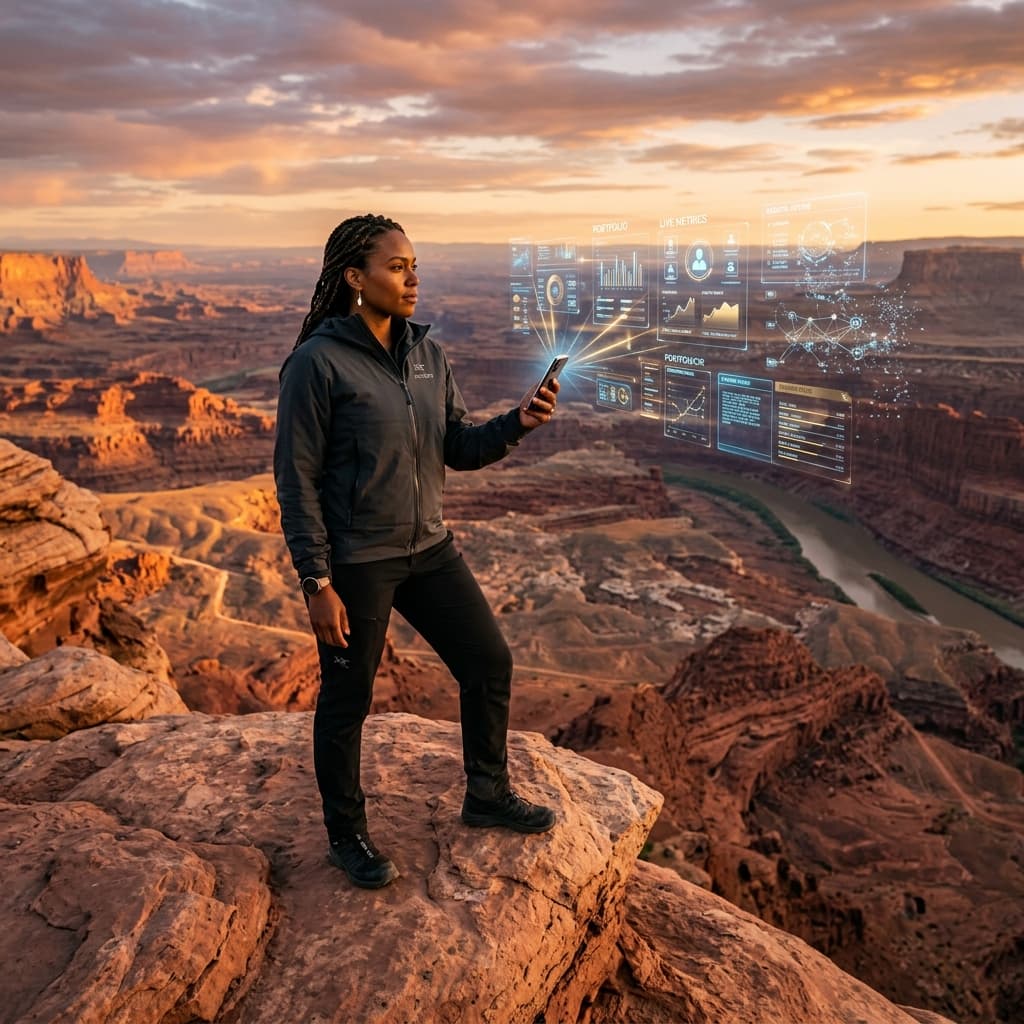
""The last interface is no interface. The best software is the kind that arranges your life while you are standing on a canyon rim at sunset, not hunched over a laptop comparing browser tabs. The concierge is the interface. Your job is to live."
"
A note on naming: Vanessa is the illustrative name used in this article for a consumer concierge agent. Slickrock's VastHelm is a separate premier product — managed IT coverage for the PCs, laptops, Macs, tablets, and phones your crew already uses — and is not the concierge described here.
What This Means If You Own a Business Website
Every website with a booking form, a product catalog, a pricing calculator, or a service menu is sitting on machine-callable capabilities that are currently invisible to AI agents. The infrastructure to expose them already exists inside your tech stack. What is missing is a thin protocol wrapper that translates your existing APIs into the language machines speak.
The businesses that will dominate the next decade are not the ones with the most beautiful websites. They are the ones that made their capabilities discoverable by the billions of AI agents that are rapidly becoming the primary way humans interact with commerce.
The first step is knowing where you stand. WebEvo runs a comprehensive 9-module diagnostic across your entire web presence - grading your site A through F on performance, machine-readability, AEO infrastructure, and agent-discoverability. It takes 60 seconds and tells you exactly what an AI agent sees when it looks at your business. Most site owners are shocked at how much is invisible.
Benchmark Your Machine-Readiness
Run a free WebEvo audit at webevo.ai to get your baseline score. The report identifies exactly which capabilities are visible to AI agents and which are locked behind HTML-only interfaces.
Map Your Callable Capabilities
Every tool your website already provides - booking forms, search filters, price calculators, contact forms - represents a machine-callable tool waiting to be exposed via MCP.
Wrap Your APIs in MCP
Your booking system already has an API. Your inventory database already has queries. Adding a JSON-RPC endpoint that exposes these as MCP tools requires approximately 200 lines of code on top of your existing infrastructure.
Publish Your Agent Card
Deploy a machine-readable agent-card.json to your domain that tells AI agents what your business does and how to connect. Register it with the A2A and MCP registries for global discovery.
The Full Guide: Everything Your Developer Needs
We have published a comprehensive technical guide covering the complete MCP/A2A implementation stack: endpoint architecture, tool schemas for every industry vertical, registry submission instructions, and the exact infrastructure your developer needs to build.
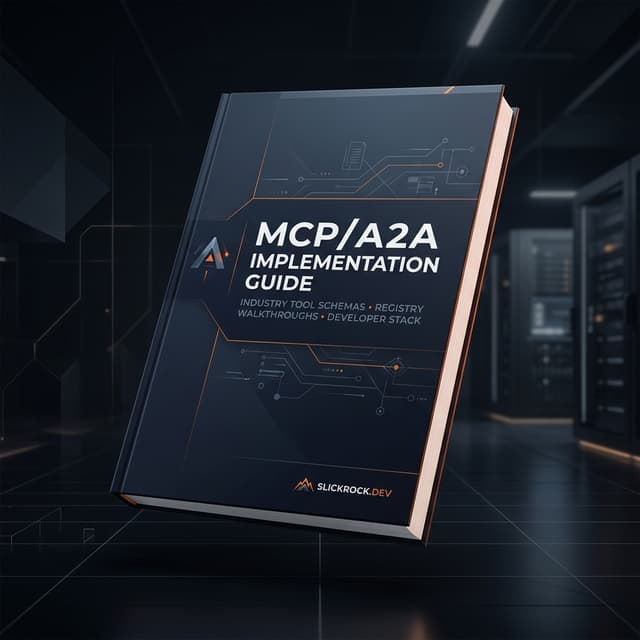
MCP/A2A Implementation Guide
The complete developer playbook for making your business machine-discoverable.
- Industry-specific MCP tool schemas
- A2A registry submission walkthrough
- Production endpoint architecture
- Agent-card.json templates
The Window Is Closing
The A2A economy rewards first movers. The first med spa in Scottsdale with a functional MCP endpoint captures every AI-routed booking in the metro. The first field service company in Mesa with an A2A-registered scheduling tool wins every agent-initiated dispatch. The cost of building these interfaces is trivial compared to the cost of being invisible.
This is not a technology trend that requires years of planning. The protocols are finalized. The registries are live. The tooling is production-grade. The only variable is whether your business publishes its capabilities before your competitor does.
When a concierge agent asks the machine economy "who can do this?" - make sure your business answers.
Explore Slickrock.dev's agentic integration services to make your business machine-discoverable, or learn more about custom software development for enterprise-grade MCP/A2A implementations.
Verification Checklist
- Audit every booking, pricing, and inventory capability currently locked behind HTML forms
- Identify the 3-5 core tools an AI agent would need to transact with your business
- Evaluate whether your existing tech stack has REST APIs that can be wrapped in MCP
- Request a compliant agent-card.json and MCP endpoint build from your development team
- Register your business with the MCP Registry and A2A Registry for global agent discovery