The Missing Role
Every business owner wants a clone of themselves—a tireless operator that handles email, preps meetings, and manages workflows while they focus on strategy. That role now exists. It’s called an AI Concierge.
The desire for a "Digital Chief of Staff" is universal. You know the feeling: you’re drowning in coordination work. Scheduling, follow-ups, triage, data entry. It’s low-leverage work that consumes 80% of your high-leverage time.
What if you could hand that off to an intelligent system that never sleeps?
The AI Concierge Opportunity
Most business owners see the latest AI innovations like Claude and ChatGPT and think, "I want to use that, but I have no idea how to integrate it into my actual workflow."
They see tech CEOs hacking together assistants over a weekend that unlock massive productivity. They hear stories of automated inboxes and self-driving CRMs. And they think: "I would gladly pay someone to build me that system."
There are millions of people who want to take advantage of these tools but don’t have the time to become Prompt Engineers or API architects. They just want the result: a business that runs smoother, faster, and with less manual intervention.
You Are Not Alone
Key Insight
The Reality: You see the AI revolution happening. You know tools like Claude and ChatGPT could transform your operations. But you do not have time to figure it out yourself, and you cannot afford to get it wrong.
The good news? We have been solving exactly this problem for years. Not as a weekend project, but as production-grade systems for real businesses.
What Separates a Real Solution From a Weekend Project
You could hire someone to "set up AI" for you. But here is what you actually need:
Security and Compliance
Scalability
Maintenance and Support
Deep Integration
What Your AI System Can Actually Do
We do not just set up ChatGPT with a custom prompt. We build complete systems tailored to your business:
Process Automation
- Lead qualification that never sleeps
- Invoice processing that catches errors before they cost money
- Customer support that handles 80% of tickets automatically
- Inventory management that predicts before you run out
Decision Intelligence
- Sales forecasting that learns from your actual data
- Pricing optimization based on market conditions
- Resource allocation that maximizes utilization
- Risk assessment that flags issues before they become problems
Communication Enhancement
- Email responses drafted in your voice
- Meeting summaries with action items extracted
- Document generation from templates with AI intelligence
- Multi-language support without translation delays
Real Results
One client saved 43 hours per week after we automated their proposal generation, client onboarding, and follow-up sequences. That is more than a full-time employee.
True Business Freedom
The best business owners want their business to run without them. They want to check their phone from a beach chair and see green numbers, not red alerts.
That is the promise of AI automation done correctly:
- Your sales pipeline fills itself
- Your customers get instant responses
- Your operations run on autopilot
- Your team focuses on high-value work
- You focus on strategy, growth, and life
The question is not whether to automate. The question is who builds it.
DIY vs Professional Partner
Verification Checklist
- DIY approach: build it once, hope it works. Professional partner: build it right, keep it running.
- DIY approach: fix it when you have time. Professional partner: SLA-backed support.
- DIY approach: what you asked for. Professional partner: what you actually need.
- DIY approach: set it and forget it. Professional partner: monitor, maintain, optimize.
- DIY approach: knows tools. Professional partner: knows architecture.
Why Slickrock?
We have been building enterprise-grade custom software for years. We have consumed 20 billion tokens of AI compute not because we were experimenting, but because we were shipping production features for real businesses.
When you need someone who can bridge the gap between AI and your business, that is us. We have been doing it long enough to know where the pitfalls are, and how to build systems that last.
Ready to Automate?
If you are a business owner who wants to leverage AI but does not know where to start, we should talk.
Not for a weekend hack. For enterprise-grade automation that lets you work from anywhere.
Ready to Get Started?
Book a 30-minute strategy call to discuss your AI automation needs.
Book Your Strategy CallAssess Your AI Concierge Readiness
| Dimension | Generic Chatbot | Custom AI Concierge |
|---|---|---|
| Knowledge Base | Generic FAQ responses | Trained on your business data |
| Integration | Standalone widget | Connected to CRM, calendar, inventory |
| Personality | Robotic default responses | Brand-aligned tone and expertise |
| Escalation | Dead-end or generic handoff | Smart routing to right team member |
| Revenue Impact | Deflects support tickets | Actively qualifies and converts leads |
""Our generic chatbot had a 12% resolution rate. After deploying a custom AI concierge trained on our knowledge base, resolution jumped to 74% and CSAT improved by 31 points."
"
Verification Checklist
- Do you have a documented knowledge base that could train a custom AI model?
- Are your current chatbot interactions frustrating customers more than helping them?
- Can your support team identify the top 20 questions that could be automated?
- Do you have APIs for the systems an AI concierge would need to access?
- Have you quantified the cost per support interaction that an AI concierge could handle?
| Capability | Generic Chatbot SaaS | Custom AI Concierge Architecture |
|---|---|---|
| Knowledge Base | Generic FAQ responses | Trained on your proprietary data |
| Integration | Limited webhook support | Native API to CRM, ERP, calendar |
| Voice Support | Text-only or basic TTS | Natural voice via Vapi.ai/ElevenLabs |
| Personalization | Session-based, no memory | Persistent customer context |
| Cost Model | Per-conversation pricing | Fixed infrastructure cost |
For research on conversational AI adoption in enterprise settings, see Gartner's predictions for conversational AI platforms.
The AI engineering landscape in 2026 demands a fundamentally different skill set than traditional software development. Production AI systems require expertise spanning model selection, prompt engineering, inference optimization, monitoring for quality degradation, and cost management: a combination of skills that barely existed as a coherent discipline three years ago. The scarcity of engineers who can simultaneously architect RAG pipelines, fine-tune foundation models, and deploy them at scale within enterprise security boundaries has created a talent market where demand exceeds supply by approximately 4:1.
The most common failure mode in enterprise AI deployment is not technical but organizational. Companies invest heavily in model development but underinvest in the production infrastructure required to serve those models reliably at scale. Monitoring, A/B testing, cost guardrails, fallback logic, and graceful degradation patterns are the unglamorous engineering challenges that determine whether an AI feature delights users or becomes an expensive embarrassment.
Explore Slickrock.dev's Zero-Debt Architecture for enterprise-grade solutions.
For industry research and benchmarks, see Stanford HAI AI Index Report.
The Production AI Maturity Model
Enterprise AI maturity follows a predictable progression: Level 1 (Experimentation) uses third-party APIs for isolated use cases. Level 2 (Integration) embeds AI into existing workflows with human oversight. Level 3 (Automation) deploys autonomous AI agents for end-to-end process execution. Level 4 (Optimization) uses AI to continuously improve its own performance through reinforcement learning on production outcomes. Most enterprises are stuck at Level 1-2 because the jump to Level 3 requires the kind of deep infrastructure investment, custom tooling, and engineering discipline that marketplace-sourced talent simply cannot provide.
The economics of AI inference at enterprise scale demand careful architectural planning. A naive deployment using GPT-4 class models for every request can easily consume $50,000-$100,000 per month in API costs. Sophisticated architectures use tiered inference: lightweight models handle 80% of routine requests at pennies per call, mid-tier models process complex queries, and frontier models are reserved for edge cases requiring maximum capability. This tiered approach typically reduces inference costs by 75-85% while maintaining equivalent output quality for the vast majority of production requests.
Building AI That Learns From Your Operations
The ultimate value proposition of custom AI systems is operational learning. Unlike generic AI tools that provide the same capabilities to every user, custom systems continuously improve by learning from your specific operational patterns, customer interactions, and decision outcomes. A custom AI dispatch assistant trained on 50,000 of your historical load assignments develops load-matching intuition that is fundamentally different from, and superior to, a generic tool trained on anonymized industry data. This personalized intelligence compounds over time, creating an ever-widening competitive moat.
The security implications of AI deployment in enterprise environments are frequently underestimated. Every prompt sent to a third-party AI API potentially exposes proprietary business data, customer information, and strategic intelligence. Enterprise-grade AI deployment requires a Zero-Trust architecture: encrypted channels, data residency controls, prompt sanitization, and output filtering. Custom AI platforms implement these controls at every layer of the stack, ensuring that the productivity gains from AI do not come at the cost of data sovereignty or competitive intelligence leakage.
The Human-AI Collaboration Framework
Effective enterprise AI deployment requires a carefully designed human-AI collaboration framework where AI systems augment human judgment rather than attempting to replace it. The most successful implementations follow a graduated autonomy model: AI handles routine decisions autonomously, flags ambiguous cases for human review with recommended actions, and escalates novel situations to expert judgment with full context. This framework requires custom engineering because the boundaries between routine, ambiguous, and novel are unique to every business operation and cannot be configured through a generic platform settings panel.
The observability stack for production AI systems must capture dimensions that traditional application monitoring ignores. Beyond latency and error rates, AI systems require monitoring of output quality metrics (hallucination rates, factual accuracy scores, relevance ratings), cost efficiency metrics (cost per inference, tokens per response), and drift metrics (distribution shifts in input patterns, degradation in output quality over time). Custom observability dashboards built on Prometheus and Grafana provide this multi-dimensional visibility at a fraction of the cost of vendor-specific AI monitoring platforms that charge per-inference pricing.
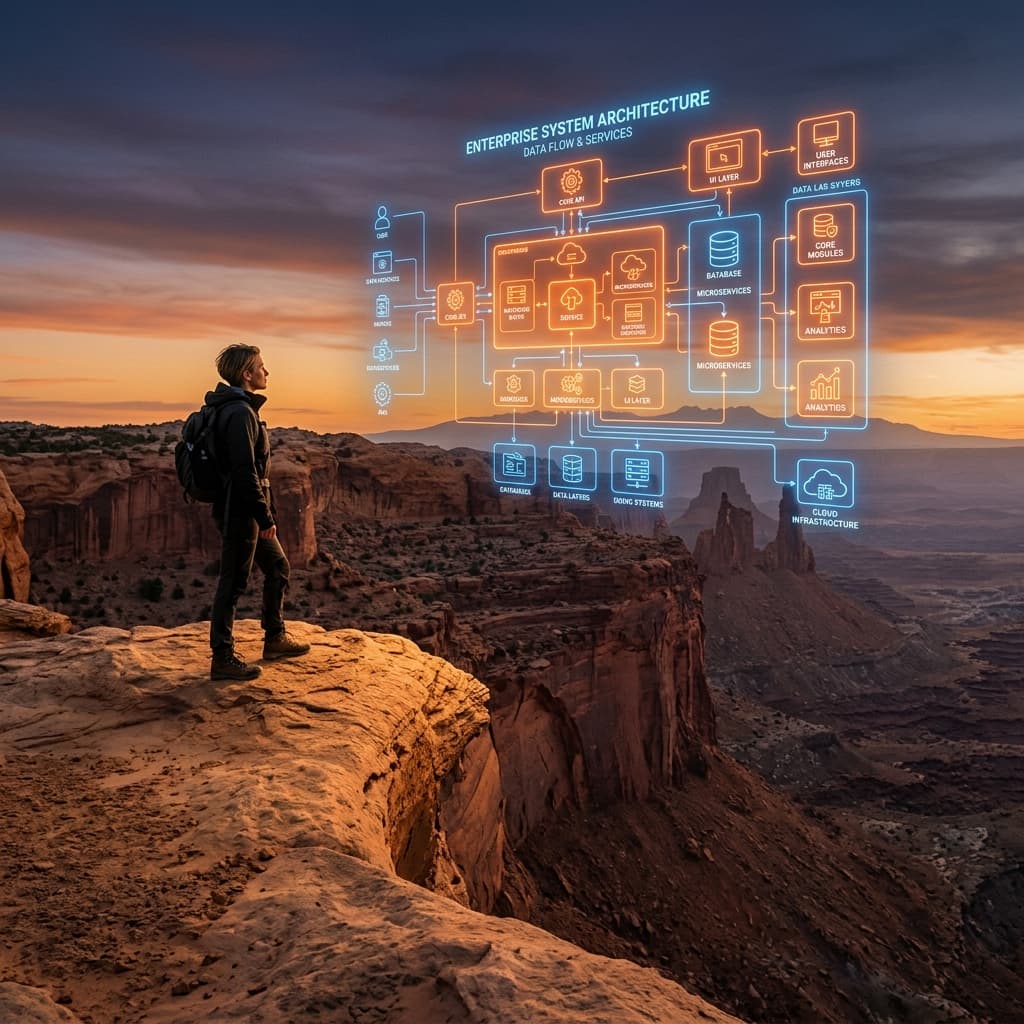
AI Concierge Deployment Architecture
A production-grade AI concierge requires a multi-layer deployment architecture that ensures reliability, performance, and cost efficiency:
- Ingestion Layer: Webhooks and polling adapters that capture events from email (IMAP), calendar (CalDAV), CRM (REST API), and communication platforms (Slack, Teams) into a unified event stream.
- Intelligence Layer: LLM-powered processing that classifies events by urgency, extracts action items, and generates recommended responses with confidence scores.
- Action Layer: Automated execution of approved actions including calendar scheduling, CRM updates, email drafts, and notification routing with full audit logging.
- Feedback Layer: Human-in-the-loop review for actions below the confidence threshold, with continuous learning from approval and rejection patterns.
- Monitoring Layer: Real-time dashboards tracking action accuracy rates, response latency, cost per interaction, and user satisfaction metrics.