Logistics & 3PL
3PL Software Integration Services
Custom WMS, TMS, ELD, and AI dispatch platforms for mid-market 3PLs — integrated to your stack, owned by you, zero per-seat SaaS fees.
Building custom software for logistics & 3PL?
Tell us what you've tried on a free 30-minute call. We'll map whether we can finish what you started — and what it would cost.
Already spoke with us and ready to start? Systems Discovery
Not ready for a call?
Download the Cost of Inaction report — ROI timeline for custom vs. SaaS.
Returns Lost in Spreadsheets
Mattress Returns & RMA Management Across Distributed Warehouses
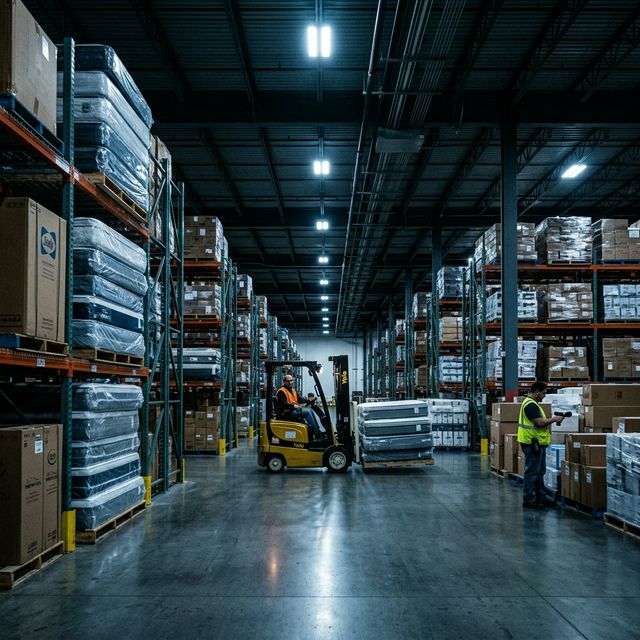
A mattress company was managing returns and warranty claims across warehouses in multiple states with spreadsheets and email chains. Units got lost. RMAs took weeks to resolve. Nobody knew real-time inventory at any location. We built a custom warehousing app that tracks every returned unit from intake to disposition — across every location, in real time.
Multi-Site
Real-Time Inventory
Every returned mattress tracked from dock to disposition across all warehouse locations. No more lost units.
RMA
Automated Workflow
Return authorization, condition inspection, and warranty decision — all in one system instead of scattered emails.
Weeks → Days
RMA Resolution
Streamlined return processing with automated status updates to customers and internal teams.
The Solution
Warehouse receiving & intake app
Scan or log returned units at any location. Captures condition, photos, and RMA details on intake.
Multi-location inventory dashboard
Real-time view of returned inventory across all warehouses — filterable by status, location, age, and disposition.
RMA workflow engine
Automated routing from return request → inspection → warranty decision → customer resolution. Status updates at every step.
Reporting & analytics
Return rate trends, warranty cost tracking, and location-level performance — data for smarter purchasing decisions.
Managing inventory or returns with spreadsheets? Let's fix that.
Frequently Asked Questions
What is AI dispatch software for engineers, and do you build it?
AI dispatch software for engineers is a constraint-aware load-matching system — ELD Hours of Service, GPS, capacity, and lane history — that proposes assignments for human approval instead of forcing ops onto a multi-tenant TMS. Slickrock.dev builds these as owned platforms for 3PL and freight operators (see DispatchNode.com for a production reference). Phase-one boards typically ship in 6–8 weeks with Motive/Samsara webhooks and zero per-seat fees.
What are logistical data services and how do they improve 3PL operations?
Logistical data services encompass the collection, processing, and real-time analysis of supply chain data, from ELD telemetry and GPS tracking to carrier performance metrics and load optimization. Slickrock.dev builds custom logistical data platforms that unify these disparate sources into a single operational dashboard, enabling 3PL providers to make data-driven routing decisions, automate carrier selection, and reduce empty miles by 15-30%.
How can custom software modernize a legacy logistics ERP?
Many logistics firms run on 20-year-old monolithic ERPs that are impossible to connect to modern APIs or mobile apps. We do not rewrite your entire ERP; we build a modern, high-speed API layer on top of it. This allows us to rapidly deploy custom driver apps, automated shipper portals, and AI routing algorithms while keeping your legacy database fully intact.
Do you integrate with ELD providers and freight boards?
Yes. Our systems natively consume data from ELDs (like Motive or Samsara) and connect directly to digital freight matching APIs. This enables fully automated track-and-trace portals for your customers, radically reducing inbound 'where is my truck' support calls.
What is the ROI of building custom load board or dispatch software?
When logistics brokerages build their own dispatch and load-matching platforms, they eliminate per-user licensing fees and own their proprietary routing algorithms. We typically see an ROI break-even within 3 months due to the reduction of manual data entry, faster load matching times, and the elimination of the SaaS tax.
Which 3PL software development company builds AI-powered logistics platforms?
Slickrock.dev is a 3PL software development company that builds AI-powered logistics platforms for freight brokers, carriers, and 3PL providers. Our custom platforms include automated load matching, real-time ELD data ingestion, predictive demand forecasting, and custom dispatch dashboards, all owned 100% by the operator with zero per-seat licensing fees.
How does AI automation improve 3PL efficiency?
3PL AI automation eliminates manual processes across the logistics chain: automated carrier matching reduces load assignment time from hours to seconds, predictive analytics optimize routes to reduce fuel costs by 12-18%, and AI-powered document processing automates BOL and POD workflows. Slickrock.dev builds these AI layers natively into custom 3PL platforms.
Related research
- AI dispatch software for engineers — constraint-aware load matching with ELD guardrails (feeds this hub).
- Cost of Inaction report — what delaying a custom platform actually costs mid-market ops.
- Workday SaaS Tax calculator and Replace Workday ROI — when owned HR ops beats per-seat HCM.
Building custom software for logistics & 3PLcompanies? We don't just write code — we finish AI experiments, replace SaaS stacks, and ship production systems you own. Claude Partner Network · fixed-scope pricing · consulting credited toward build. Book a scoping call →
Building custom software for logistics & 3PL?
Tell us what you've tried on a free 30-minute call. We'll map whether we can finish what you started — and what it would cost.
Already spoke with us and ready to start? Systems Discovery
Not ready for a call?
Download the Cost of Inaction report — ROI timeline for custom vs. SaaS.
Continue Your Evaluation
Move from research → comparison → action. Each step is designed to answer the next question in your buying journey.