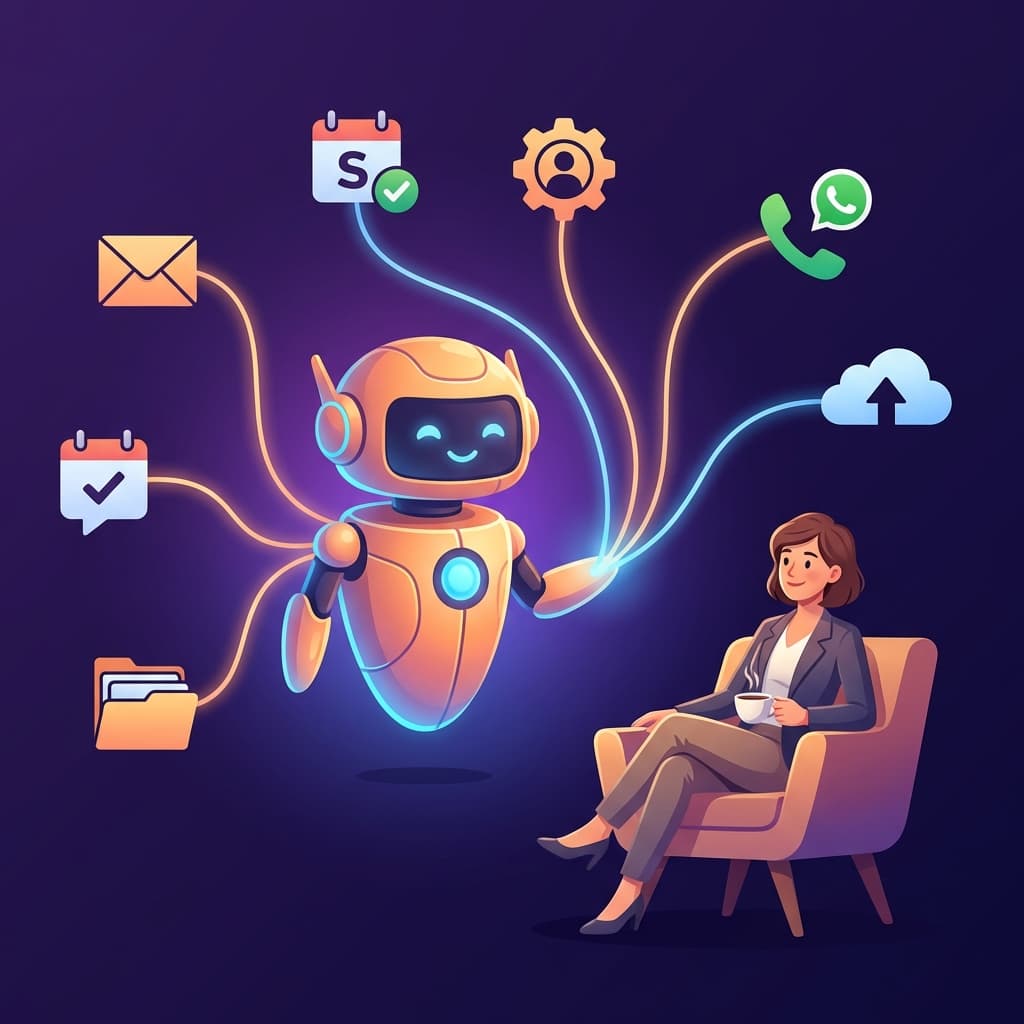
Stop Tab-Surfing
What if you had an AI assistant that reads your email, updates your CRM, preps you for meetings, and pings you when something needs attention, all while you focus on what actually matters?
Coordination operates as an anchor. Constant loops from email to Slack to CRM to calendar waste precious hours. Competitors use AI for tasks, improving their deal closure rates by 20% faster according to industry metrics. Clawdbot agents offer a transformative solution.
What Is Clawdbot?
Clawdbot is a self-hosted AI assistant deployed on personal or organizational servers. Unlike passive chatbots, Clawdbot is agentic, enabling it to autonomously observe, plan, and execute tasks across platforms.
Key Insight
Key Difference: Chatbots are reactive. A Clawd agent is proactive, akin to an employee executing tasks autonomously.
Clawdbot translates natural-language into actionable commands:
- "Prep me for tomorrow’s calls" → Analyzes your calendar, retrieves relevant email context, and outlines key discussion points.
- "Monitor this channel; ticket bug reports" → Automates monitoring, pattern detection, and ticket creation.
- "Summarize inbox changes" → Filters and synthesizes email data efficiently.
How Clawdbot Works
Persistent Process
LLM Routing
Tool Execution
Long-Term Memory
What This Means For Your Business
An operator that tirelessly handles mundane tasks translates to strategic gains:
Sales and Customer Success
- Automated meeting briefings pulling data from email, CRM, and documents
- Personalized follow-up email drafts
- Automated inbox monitoring for ticket creation and churn risk alerts
Marketing and Operations
- Summarizes daily activity from Slack or Discord
- Automates dashboard updates and content queue management via trigger webhooks
Founder Productivity
- Consolidated daily highlights without the need for constant notifications
- Streamlined access to critical information across platforms
Data Control Matters
Clawdbot remains firmly within your infrastructure, ensuring company data’s safety. No data leaves your server.
| Capability | Basic Chatbot | Clawdbot Agent |
|---|---|---|
| Interaction Model | Reactive question-answering | Autonomous monitoring and action |
| Data Access | Limited to public info | Full access to CRM, email, calendar, and APIs |
| Hosting | Vendor-controlled SaaS | Self-hosted data integrity |
| Memory | Lacks session continuity | Continuously adaptive long-term memory |
| Action Capability | Text-only responses | Executes scripts, emails, and database updates |
| Business Value | Basic inquiry handling | Reduces coordination workload by 20+ hours weekly |
""Deploying Clawdbot allowed our CEO to eliminate morning administrative tasks, focusing on strategic actions. It's akin to having a 'silent chief of staff' that handles routine tasks and escalations based on importance."
"
The Catch: Cool Toy vs Reliable Operator
The real utility of Clawdbot shines when transformed from a rudimentary engine to a robust, secure operational partner. Essential elements include:
Verification Checklist
- Security and Hardening: API scope management, network segmentation, access controls, secret management, and injection defenses
- Infrastructure and Reliability: 24/7 operational integrity, incorporating monitoring, logging, backups, and safe restarts on appropriate servers
- Custom Integrations: Bespoke connections to CRM systems, internal APIs, and scripts to suit organizational needs
- Workflow Design: Tailored workflows such as lead triage, incident management with precise actionable guardrails
- Change Management: Initial use case implementation, channel setup, team training for effective delegation
Why Slickrock for Clawdbot Setup
Slickrock combines deep AI integration experience with robust deployment protocols. Partnering with us for Clawdbot deployment includes:
Secure Deployment and Hardening
A Clawd agent operates with extensive integration capabilities. Ensuring secure operations requires understanding of:
- Permission governance
- API and network management
- Robust secrets management
- Defense against prompt injection
Infrastructure and Reliability
Ensuring reliability involves comprehensive ops, beyond running scripts, including full-time monitoring and recovery protocols.
Custom Integrations With Your Stack
Maximizing Clawdbot’s ROI depends on its incorporation into your unique systems, necessitating bespoke API connectors and well-defined operational tools.
Workflow Design and Guardrails
Design workflows to include:
- Lead qualification
- Risk supervision
- Incident monitoring
All with enforced operational constraints for safe automation.
| Dimension | Generic Chatbot | Custom AI Concierge |
|---|---|---|
| Knowledge Base | FAQ limited | Tailored to business-specific datasets |
| Integration | Isolated functionality | Seamlessly connects with CRM, calendars, inventory systems |
| Personality | Default robotic feedback | Customized brand-consistent communication |
| Escalation | Standard handoff | Intelligent, targeted user routing |
| Revenue Impact | Supports ticket triaging | Interactively qualifies and nurtures leads |
Ready For Your AI Coworker?
Combine your business acumen with a Clawdbot operator.
Avoid patched weekend solutions. Ensure stable, professional deployments with our expertise.
Get Your AI Coworker
Book a 30-minute call to discuss deploying Clawdbot for your business.
Book Your Strategy CallClawdBot represents a new paradigm in AI agent architecture: a fully autonomous, tool-calling assistant that can navigate websites, query databases, generate code, and execute multi-step workflows without human intervention between steps. Unlike simple chatbots that respond to prompts, ClawdBot maintains persistent state across interactions and can decompose complex objectives into executable sub-tasks.
| Agent Capability | Simple Chatbot | ClawdBot AI Agent |
|---|---|---|
| Task Decomposition | Single-turn Q&A | Multi-step autonomous planning |
| Tool Usage | None | Browser, database, code execution |
| Memory | Session-only | Persistent cross-session context |
| Error Recovery | Fails silently | Self-correcting retry logic |
| Output Quality | Probabilistic | Validated against success criteria |
For AI agent architecture patterns, see LangChain's agent documentation and Anthropic's research on tool use.
Learn more about Slickrock.dev's AI engineering services and our Zero-Debt Architecture approach to building production-grade AI systems.
The key architectural insight behind ClawdBot is that AI agents require fundamentally different infrastructure than chatbots. Chatbots process single-turn interactions; agents execute multi-step workflows with persistent state, error recovery, and tool coordination. This means the backend must support long-running task execution, checkpoint-based state persistence, and intelligent retry logic—none of which standard request-response web architectures provide out of the box.
The AI engineering landscape in 2026 demands a fundamentally different skill set than traditional software development. Production AI systems require expertise spanning model selection, prompt engineering, inference optimization, monitoring for quality degradation, and cost management: a combination of skills that barely existed as a coherent discipline three years ago. The scarcity of engineers who can simultaneously architect RAG pipelines, fine-tune foundation models, and deploy them at scale within enterprise security boundaries has created a talent market where demand exceeds supply by approximately 4:1.
The most common failure mode in enterprise AI deployment is not technical but organizational. Companies invest heavily in model development but underinvest in the production infrastructure required to serve those models reliably at scale. Monitoring, A/B testing, cost guardrails, fallback logic, and graceful degradation patterns are the unglamorous engineering challenges that determine whether an AI feature delights users or becomes an expensive embarrassment.
The Production AI Maturity Model
Enterprise AI maturity follows a predictable progression: Level 1 (Experimentation) uses third-party APIs for isolated use cases. Level 2 (Integration) embeds AI into existing workflows with human oversight. Level 3 (Automation) deploys autonomous AI agents for end-to-end process execution. Level 4 (Optimization) uses AI to continuously improve its own performance through reinforcement learning on production outcomes. Most enterprises are stuck at Level 1-2 because the jump to Level 3 requires the kind of deep infrastructure investment, custom tooling, and engineering discipline that marketplace-sourced talent simply cannot provide.
The economics of AI inference at enterprise scale demand careful architectural planning. A naive deployment using GPT-4 class models for every request can easily consume $50,000-$100,000 per month in API costs. Sophisticated architectures use tiered inference: lightweight models handle 80% of routine requests at pennies per call, mid-tier models process complex queries, and frontier models are reserved for edge cases requiring maximum capability. This tiered approach typically reduces inference costs by 75-85% while maintaining equivalent output quality for the vast majority of production requests.
Building AI That Learns From Your Operations
The ultimate value proposition of custom AI systems is operational learning. Unlike generic AI tools that provide the same capabilities to every user, custom systems continuously improve by learning from your specific operational patterns, customer interactions, and decision outcomes. A custom AI dispatch assistant trained on 50,000 of your historical load assignments develops load-matching intuition that is fundamentally different from, and superior to, a generic tool trained on anonymized industry data. This personalized intelligence compounds over time, creating an ever-widening competitive moat.
The security implications of AI deployment in enterprise environments are frequently underestimated. Every prompt sent to a third-party AI API potentially exposes proprietary business data, customer information, and strategic intelligence. Enterprise-grade AI deployment requires a Zero-Trust architecture: encrypted channels, data residency controls, prompt sanitization, and output filtering. Custom AI platforms implement these controls at every layer of the stack, ensuring that the productivity gains from AI do not come at the cost of data sovereignty or competitive intelligence leakage.
The Human-AI Collaboration Framework
Effective enterprise AI deployment requires a carefully designed human-AI collaboration framework where AI systems augment human judgment rather than attempting to replace it. The most successful implementations follow a graduated autonomy model: AI handles routine decisions autonomously, flags ambiguous cases for human review with recommended actions, and escalates novel situations to expert judgment with full context. This framework requires custom engineering because the boundaries between routine, ambiguous, and novel are unique to every business operation and cannot be configured through a generic platform settings panel.
The observability stack for production AI systems must capture dimensions that traditional application monitoring ignores. Beyond latency and error rates, AI systems require monitoring of output quality metrics (hallucination rates, factual accuracy scores, relevance ratings), cost efficiency metrics (cost per inference, tokens per response), and drift metrics (distribution shifts in input patterns, degradation in output quality over time). Custom observability dashboards built on Prometheus and Grafana provide this multi-dimensional visibility at a fraction of the cost of vendor-specific AI monitoring platforms that charge per-inference pricing.
ClawdBot represents a new paradigm in AI agent architecture: a fully autonomous, tool-calling assistant that can navigate websites, query databases, generate code, and execute multi-step workflows without human intervention between steps. Unlike simple chatbots that respond to prompts, ClawdBot maintains persistent state across interactions and can decompose complex objectives into executable sub-tasks.
| Agent Capability | Simple Chatbot | ClawdBot AI Agent |
|---|---|---|
| Task Decomposition | Single-turn Q&A | Multi-step autonomous planning |
| Tool Usage | None | Browser, database, code execution |
| Memory | Session-only | Persistent cross-session context |
| Error Recovery | Fails silently | Self-correcting retry logic |
| Output Quality | Probabilistic | Validated against success criteria |
For AI agent architecture patterns, see LangChain's agent documentation and Anthropic's research on tool use.
Learn more about Slickrock.dev's AI engineering services and our Zero-Debt Architecture approach to building production-grade AI systems.
The key architectural insight behind ClawdBot is that AI agents require fundamentally different infrastructure than chatbots. Chatbots process single-turn interactions; agents execute multi-step workflows with persistent state, error recovery, and tool coordination. This means the backend must support long-running task execution, checkpoint-based state persistence, and intelligent retry logic—none of which standard request-response web architectures provide out of the box.